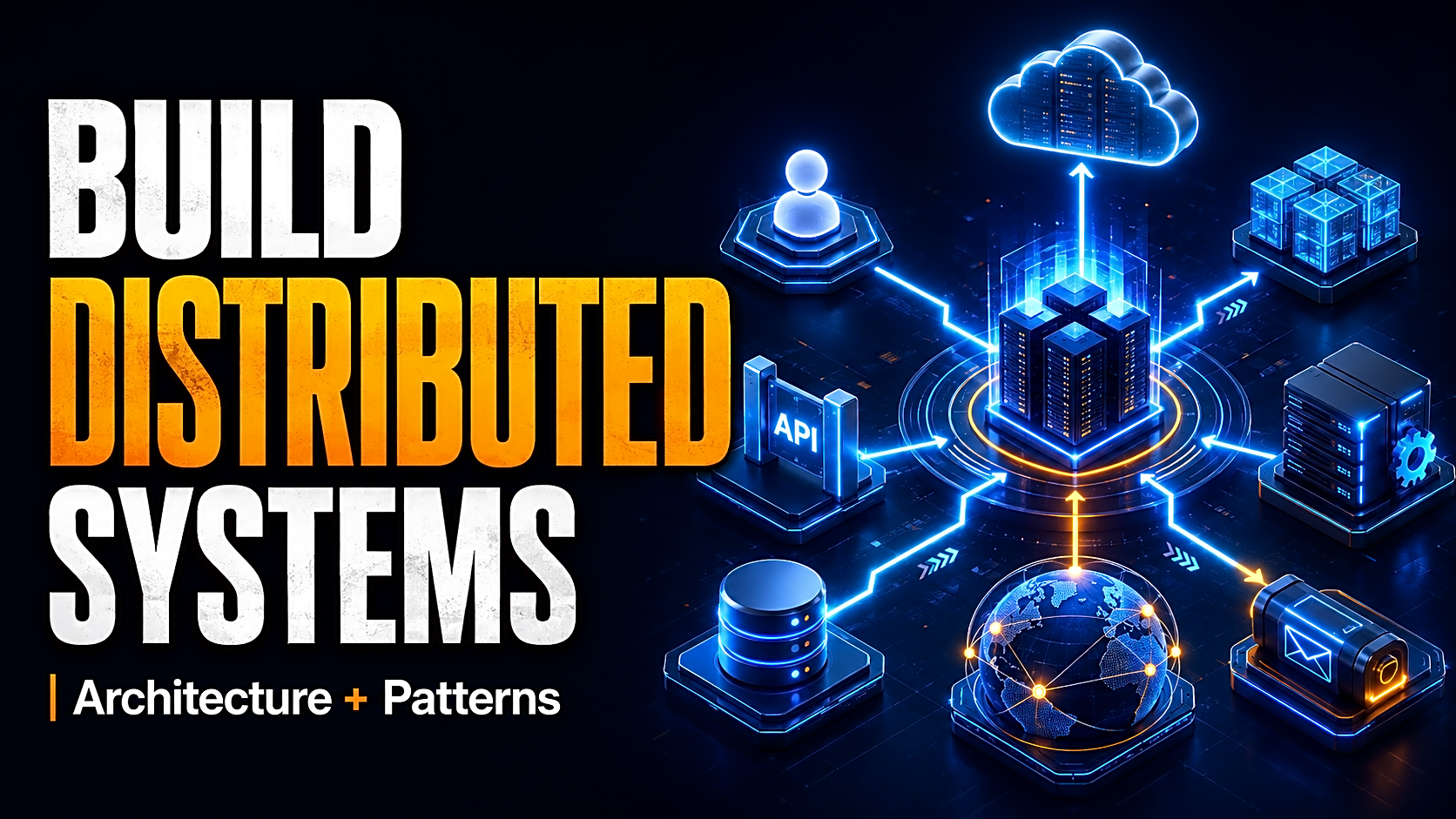
How to Build Distributed Systems: Architecture & Patterns
Build distributed systems by starting with one measurable problem—not by adding microservices for appearance. This student-focused guide explains architecture, communication, reliability, consistency, observability, and a practical build-test-document workflow.
A small web application can run perfectly well with one backend and one database. Then something changes: PDF generation blocks requests, traffic spikes overwhelm one instance, a database becomes a bottleneck, or one failing dependency brings the whole application down.
That is where building distributed systems becomes useful.
But distributed design is not simply “using many servers.” The moment components communicate across a network, you inherit latency, partial failures, duplicate requests, coordination problems, consistency trade-offs, and harder debugging.
The goal is therefore not maximum distribution. It is the smallest distributed architecture that solves a real requirement reliably.
Quick Answer: How Do You Build a Distributed System?
To build a distributed system, first define the workload and identify what needs independent scaling, fault isolation, or asynchronous processing. Separate clear responsibilities, connect components through APIs or messages, define data ownership, add timeouts and safe retries, make repeated operations idempotent, monitor requests across services, and deliberately test failure scenarios.
For most student applications, begin with a modular monolith. Distribute one component only after you can explain the problem that the new boundary solves.
What Is a Distributed System?
A distributed system is a group of independent processes or machines that coordinate over a network to provide a larger service.
A simple architecture may contain:
User
↓
Load Balancer
↓
Stateless API Instances
├── Redis Cache
├── PostgreSQL
└── Message Queue
↓
Workers
The key change is that local calls become remote interactions that can be delayed, duplicated, rejected, or completed without the caller receiving the response.
When Should You Use Distributed Architecture?
Distribution is justified when it solves a measurable problem.
|
Requirement |
Useful Pattern |
|
CPU-heavy background work |
Queue + workers |
|
More API throughput |
Stateless replicas + load balancer |
|
Repeated expensive reads |
Shared cache |
|
Read-heavy database load |
Replication |
|
Dataset exceeds one node |
Partitioning/sharding |
|
Loose downstream coupling |
Events/messages |
|
Unstable dependency |
Timeout + circuit breaker |
|
Duplicate delivery is possible |
Idempotency |
A modular monolith remains the strongest default for many academic applications because it is easier to deploy, debug, test, and explain. Use distributed components when the trade-off is visible.
Students learning architecture more broadly can first review FileMakr's system design guide and scalable web application guide.
Monolith vs Distributed System
|
Area |
Monolithic Application |
Distributed System |
|
Communication |
In-process calls |
Network calls/messages |
|
Deployment |
Usually one unit |
Multiple components |
|
Scaling |
Scale the whole app |
Scale selected workloads |
|
Data |
Often centralized |
May be replicated or partitioned |
|
Failure model |
Simpler |
Partial failures expected |
|
Transactions |
Easier |
Cross-service coordination is harder |
|
Debugging |
Local logs often enough |
Correlated logs/traces needed |
|
Operations |
Lower complexity |
Higher operational overhead |
The Core Challenges You Must Design For
Network and Partial Failures
A request can time out even when the remote service completed the operation. A worker can fail after updating the database but before acknowledging a message. One service can be healthy while another is unavailable.
Production-style designs therefore use explicit timeouts, bounded retries, exponential backoff, circuit breakers, and graceful degradation. Retries should address transient faults rather than endlessly calling a dependency that remains unhealthy. Microsoft's current architecture guidance specifically recommends combining Retry and Circuit Breaker patterns for these different failure conditions.
Duplicate Work and Delivery Guarantees
Message brokers and retry logic can cause the same work to be delivered more than once.
At-most-once prioritizes avoiding duplicate execution but can lose work. At-least-once retries delivery, so consumers must expect duplicates. What teams often want operationally is an exactly-once business effect, achieved through mechanisms such as idempotency, deduplication, transactional boundaries, or infrastructure guarantees.
For a student project, implementing an idempotency key for an order or payment request demonstrates more engineering understanding than simply writing “exactly once” in the architecture report.
Consistency, Replication, and Partitioning
Replication keeps copies of data on multiple nodes and can improve availability or read capacity. Partitioning divides a dataset so different nodes own different subsets.
A useful CAP question is:
During a network partition, does this operation reject or delay work to preserve a consistent answer, or continue serving with temporarily divergent state?
Consistency is not one global switch. A payment balance may need stronger guarantees than an analytics dashboard or notification counter.
Four Advanced Concepts Worth Understanding
1. Consensus and Leader Election
Some distributed components must agree on who is the leader, which configuration is current, or which value has been committed. Consensus algorithms such as Raft and Paxos address agreement between nodes under failure.
Application developers usually consume higher-level systems such as etcd, ZooKeeper, Consul, or managed databases rather than implement consensus themselves. Google SRE similarly describes consensus as a lower-level primitive behind practical services such as leader election, distributed locking and management of critical shared state.
2. Distributed Transactions
A database transaction is straightforward when one database owns the workflow. It becomes harder when Order, Payment and Inventory services each control separate data.
A Saga divides the workflow into local transactions and uses compensating actions when later operations fail. A transactional outbox helps prevent the classic failure where a database change succeeds but the corresponding event is never published. Microsoft's architecture guidance recommends persisting the state change and event together before publishing the event separately.
3. Backpressure and Load Shedding
Queues absorb bursts, but they do not create infinite capacity.
If producers generate work faster than consumers process it, queue depth grows and latency increases. Backpressure limits or slows incoming work, while load shedding deliberately rejects lower-priority work to protect critical operations.
4. Service Discovery and Observability
As service instances scale dynamically, callers need a reliable way to locate healthy destinations through mechanisms such as DNS, service registries, load balancers or orchestration.
Observability must also cross process boundaries. Correlation IDs and distributed traces allow one request to be followed through several services. OpenTelemetry identifies context propagation as the core mechanism that enables this cross-service trace relationship.
For a deeper implementation guide, see FileMakr's application logging and monitoring guide.
Practical Student Case Study: Placement Platform
Consider a placement portal where students upload resumes and generate formatted PDF reports.
Stage 1: Start Simple
Browser → API → PostgreSQL
Authentication, placement records, CRUD operations and normal queries stay in one application.
Stage 2: Move Expensive Work to a Queue
Suppose resume parsing and PDF generation begin making normal API requests slow.
API → Job Queue → Document Worker
The API stores the job, returns a job identifier, and lets workers execute expensive processing independently.
Now measure real values such as:
- p95 API latency;
- processing time;
- queue depth;
- error rate;
- CPU utilization.
Do not invent benchmark numbers for a project report.
Stage 3: Scale the API
If the API becomes the bottleneck:
┌→ API 1 ─┐
User → LB ───┼→ API 2 ─┼→ PostgreSQL
└→ API 3 ─┘
└──→ Redis
This is where caching, stateless application instances and load balancing become meaningful rather than decorative architecture.
Stage 4: Break the Architecture
Test the conditions that make distributed systems difficult:
- stop one worker;
- deliver the same message twice;
- delay a database dependency;
- make a downstream service return errors;
- overload the queue;
- restart an API instance.
Then record what failed, what recovered automatically and what the user experienced.
That evidence is more impressive than adding five more technologies to the diagram.
Reliability Patterns That Matter Most
Use a timeout for every remote dependency. Retry only operations that are safe and likely to recover. Apply exponential backoff and jitter when repeated retries could synchronize many clients. Use a circuit breaker when a dependency remains unhealthy. Send repeatedly failing messages to a dead-letter queue, and make writes idempotent when duplicate delivery is possible.
Also identify hidden single points of failure such as one database, queue, or load balancer.
Security Between Services
Distributed systems create more communication paths that require protection.
Use authenticated service-to-service communication, TLS for network traffic, least-privilege credentials, proper secret management, input validation, and authorization at the service that owns the protected resource.
Internal network traffic should not automatically be treated as trusted.
How to Document a Distributed Systems Project
Your report should explain engineering decisions rather than only displaying an architecture diagram.
Document the architecture, component responsibilities, communication model, data ownership, retry and idempotency strategy, consistency decisions, failure scenarios, monitoring approach and measured results.
The best format is:
Problem → design choice → trade-off → experiment → evidence.
For deployment, continue with FileMakr's cloud deployment guide.
Common Distributed-System Mistakes
Avoid splitting every feature into a microservice, retrying writes without idempotency, sharing databases without clear ownership, ignoring duplicate messages, assuming replication solves every availability problem, adding Kafka or Kubernetes without a requirement, and testing only the success path.
Complexity should be earned by a requirement.
Frequently Asked Questions
How does a distributed system work?
Independent components exchange requests or messages over a network and coordinate their state or work so the user experiences one larger service.
Are microservices and distributed systems the same?
No. Microservices are one approach to distributed applications. Distributed systems also include replicated databases, worker clusters, distributed caches, storage platforms and coordination services.
Is Kafka required for distributed systems?
No. Kafka is useful for particular event-streaming workloads. Many applications need only HTTP/gRPC, a simpler queue, or no message broker at all.
What should students learn before distributed systems?
Understand HTTP, APIs, databases, transactions, concurrency, networking basics, caching, queues and deployment before moving into consensus and advanced distributed transactions.
Which database is best for distributed systems?
There is no universal choice. Select according to query patterns, transaction requirements, consistency needs, expected scale, operational complexity and the team's ability to operate the technology.
What is the hardest part of distributed systems?
Failure and coordination are usually the hardest areas: network uncertainty, partial success, duplicate operations, consistency, ordering and diagnosing problems across several components.
Can distributed systems be used in a final-year project?
Yes. Use distributed architecture when the project has a justified requirement such as background processing, fault-tolerance testing, real-time events, load distribution or distributed data processing. Keep the architecture small enough to implement, test and explain properly.
Conclusion
Building distributed systems is less about adding servers and more about engineering the consequences of network boundaries.
Start simple. Measure the bottleneck. Distribute one justified workload. Define data ownership and consistency. Design timeouts, retries, idempotency and failure behaviour. Add observability. Then break the system deliberately and record what happens.
That workflow teaches the real discipline behind distributed architecture:
Every scalability or availability gain introduces coordination cost, and good engineering makes that cost explicit.
If you want to turn the architecture into an academic implementation, explore FileMakr's final-year project ideas or project source code library after defining a system you can genuinely explain, test and document.
This version is approximately 1,650–1,700 editorial words, depending on how the CMS counts code/table text, keeping it inside your requested range. Google itself does not recommend targeting a specific word count, so the range should remain an editorial constraint rather than an SEO objective.